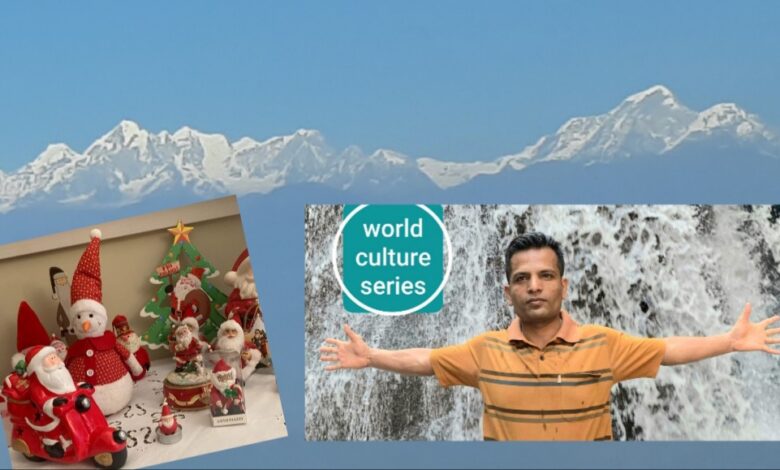
CHRISTMAS IS COMING

Ashok Silwal
In the next days, and more precisely with holidays starting from the Eve of 25th December and more or less until the 6th of January (Epiphany), the Christians will celebrate Christmas.
In the spirit of tolerance and cultural openness to others that I would like to characterize these on-line pages of Nepal Namcha, I asked some former guests from Christian countries, became friends, with whom I’m still in contact, to tell me about this celebration, chatting or writing.
So, some of them did, from Spain, from Italy, from France, from Holland, from USA, from Brazil …
Now I have tried to make a small summary, without erudite pretensions, just to know a little more (and remembering that when I was their guide, they asked me about Tihar, Dashain, Chhath, Lhosar or Basanta Panchami, etc)
Curiosity means intelligence and knowledge … ‘Without knowledge there is no happiness because knowledge sets you free’, said Socrates.
So let’s ‘know’ a little more about Christmas …
The term CHRISTMAS means ‘the day of birth’ and indicates, par excellence, the day of the birth of Jesus Christ. Around 350 AD, Pope Julius I transformed this pagan holiday into a Christian holiday, declaring December 25th the anniversary of the birth of Christ (so, an arbitrary date).
It was the custom of the pagans to celebrate the birth of the Sun on December 25 th, on winter solstice; in the honor of the sun, they lit fires as ‘a sign of festivity.’ When the Scholars of the Church noticed that Christians were too attached to this holiday, they decided in council that the ‘true’ Nativity had to be proclaimed on that day.
However, Orthodox Christmas in the Eastern countries of Russian tradition, is celebrated on January the 7th and is little different from what is used in Europe. This is due to the fact that Orthodox Church continues to use the Julian calendar and not the Gregorian one.
Christmas is the main holiday of the year. It somehow resembles to our Tihar.
This feast derives from a ‘mixture’, a kind of syncretism, overlapping of feasts of religious and secular nature.
RELIGIOUS NATURE
The Christian meaning of the feast lies in the celebration of the presence of God. With the birth of Jesus, God, for Christians, (and not for Jews who still wait for the son of God) is no longer a distant God who can only be guessed from afar but is a God who reveals himself and enters the world. In Jesus, God becomes a man and descends to earth to save humanity.
The sacred texts that tell the life of Jesus are not always in agreement: about the birth, some say he was born in a stable, others in a cave, others in a hut.. anyway on some straw.. sign of humility.
So, in the houses, a nativity scene is set up; It can be very simple or very elaborate. There are always Joseph and Mary, earthly parents of Jesus and also an ox and a donkey which, it is said, warmed the baby.
The family fled from Egypt where there were persecutions and Mary gave birth in Bethlehem (still in Palestine today- 10 km south of Jerusalem))
On the night between the 24th and 25th of December, the night of the Eve, all the churches celebrate a solemn Mass. There are always a lot of people in a joyful and respectful atmosphere. The most serious Catholics have fasted. Mass takes place at midnight before the Christmas Eve dinner. There are typical dishes and sweets of the Eve dinner; it depends on local traditions of the countries and regions: there are often lentils and turkey, maybe fish as lobster or salmon….a cake in the shape of a log ….
Usually, people dress up for parties and anyway gifts are exchanged especially for children.
People exchanges peace wishes.
A few days after Christmas, on 6th January, there is the Epiphany which celebrates the first time that Jesus showed himself to the public and was visited by the Magi.
Today, unfortunately, the religious content is a bit faded.
Many profane symbols have taken over, and often Christmas becomes a big ‘market.’
PROFANE NATURE
The two most frequent symbols, as well as candles and various garlands, are the Christmas Tree and Santa Claus.
-SANTA CLAUS, FATHER CHRISTMAS, SINTER KLASS, PÈRE NOËL, BABBO NATALE … Every country has a name…. But same character.
Father Christmas is said to have originated from Saint Nicolas. In his representation, there is all the symbolism of St Nicolas: white beard, red coat….
Santa Claus travels in a sleigh pulled by reindeers, distributing toys and gifts.
From 1821, Santa Claus knew various transformations by different writers and illustrators who added the belly and joviality, then the white fur.
In 1931, Coca-Cola arrives!!!
The American firms had the genius to ask an illustrator (Sundblom) to draw an old man drinking Coca-Cola to regain his strength during the distribution of toys. This would encourage children to drink during the winter.
The designer dressed it in the colors of the famous Coca-Cola bottle: red and white!
This new look and the fame he received from the publicity made the old man the planetary master of the magical night, Santa Claus.
There were a few protest movements on the part of the Catholics against this overwhelming popularity, the night of December 24th to 25th being originally that of the baby Jesus…. But everything fell into place over time.
Regardless, the arrival of Santa Claus (through the chimney !) remains magical for everyone and symbolizes a bond of affection, the attachment to family and friends…
Today, there are representations of Santa Claus of all sizes and all kinds of materials (ceramics, plastics, chocolate, sugar, wood, metals, glass……..) and everywhere on Christmas days!
Next to Santa Claus, in some countries, there is an ugly old man or a sort of witch who comes to punish the ‘bad’ children!!
CHRISTMAS TREE
For the pagan rite of the winter solstice, a tree, a symbol of life, was decorated with fruits, flowers and wheat… Then, in the 11th century, the Christmas tree garnished with red apples, symbolized the tree of Paradise. It was in the 12th century that the tradition of the fir tree appeared in Europe.
Since then, it has been one of the most popular Christmas customs: in many houses, a real or plastic one is prepared with colored balls, decorations, garlands, lights…..
Some choose it very small, some very large even two meters high. It is also seen in many shop windows.
It is a symbol of celebration that brings joy.
In this atmosphere, the music and Christmas songs are very important too.
Maybe the best-known song, most commonly sung in the world is ‘JINGLE BELLS.’
Here we are, dear readers ..
Through my friends’ stories, Now we ‘know’ a little more about this celebration.
When you will see exchanges of greetings and wishes on the Internet, on Messenger or WhatsApp, maybe it will ‘speak’ you a little more and you will also say HAPPY CHRISTMAS !! and it does not matter that we are Hindus, Muslims, Christians, Jews, Buddhists, Confucianists … we all need moments of joy, of trust, of hope, of celebration, of smiles, of lightness, of affection…. of HAPPY CHRISTMAS!
VERY HAPPY CHRISTMAS.
…
If you want to publish anything, we welcome you with a smile. Just remember nepalnamcha@gmail.com for it.